
Bradley Projected and Actual Release
Tennessee sentence records keep several dates apart. A sentence effective date is the calculated start after applicable rules and jail credit. A release eligibility date marks the earliest point at which the law permits a release mechanism such as parole. A sentence expiration date is the calculated endpoint. An actual release date records what happened. Only the last date, read with a release status or record, confirms that a person left custody.
The distinction is especially important in Bradley County. A person can leave Bradley County Jail through community release, but departure may instead be a transfer to TDOC, another jail, federal custody, or another authority. Tennessee's April 2025 jail report also identified state backup inmates in the local jail, showing why physical location and sentence authority do not always match. TDOC may calculate a state felony sentence while the person remains housed locally.
A pretrial detainee is different. Booking date plus a stated sentence length cannot be used when no sentence exists. Bond authorization does not prove payment, and dismissal or time-served language in court does not supply the minute discharge processing ended. Ask the jail about present custody and obtain the controlling court order.
Find Bradley Projected Release Dates
Begin by identifying the legal custodian. The official Bradley Booking Reports gate is a booking channel, not a published projected-release tool. Tennessee FOIL is designed for felony offenders currently or formerly in TDOC custody or under TDOC supervision. A county misdemeanor or a pretrial stay may never appear there.
- Check the Bradley County Booking Reports gate for the matching booking number, book date, charges, and bond fields. Treat those as intake facts only.
- Call Bradley County Jail at 423-728-7367 to learn whether the person remains housed. If not, ask whether the departure was a community release or a transfer.
- For a felony sentence or TDOC transfer, search the TDOC FOIL portal by name, TDOC/TOMIS number, or State ID. Match date of birth, photograph, offense, and identifier.
- Open the detail and copy the status, location, sentence, parole, and release fields exactly as labeled. Do not relabel eligibility as scheduled release.
- Check the Bradley criminal court judgment for sentence structure, jail credit, amended orders, probation, and the legal basis for any county release.
- Confirm physical departure through the jail or TDOC release record. A state status change should be compared with any next custody or supervision status.
The Bradley County release search and record process supplies the broader path for a named person when the destination after jail is unknown.
The official TDOC FOIL overview identifies the information the state system can display.
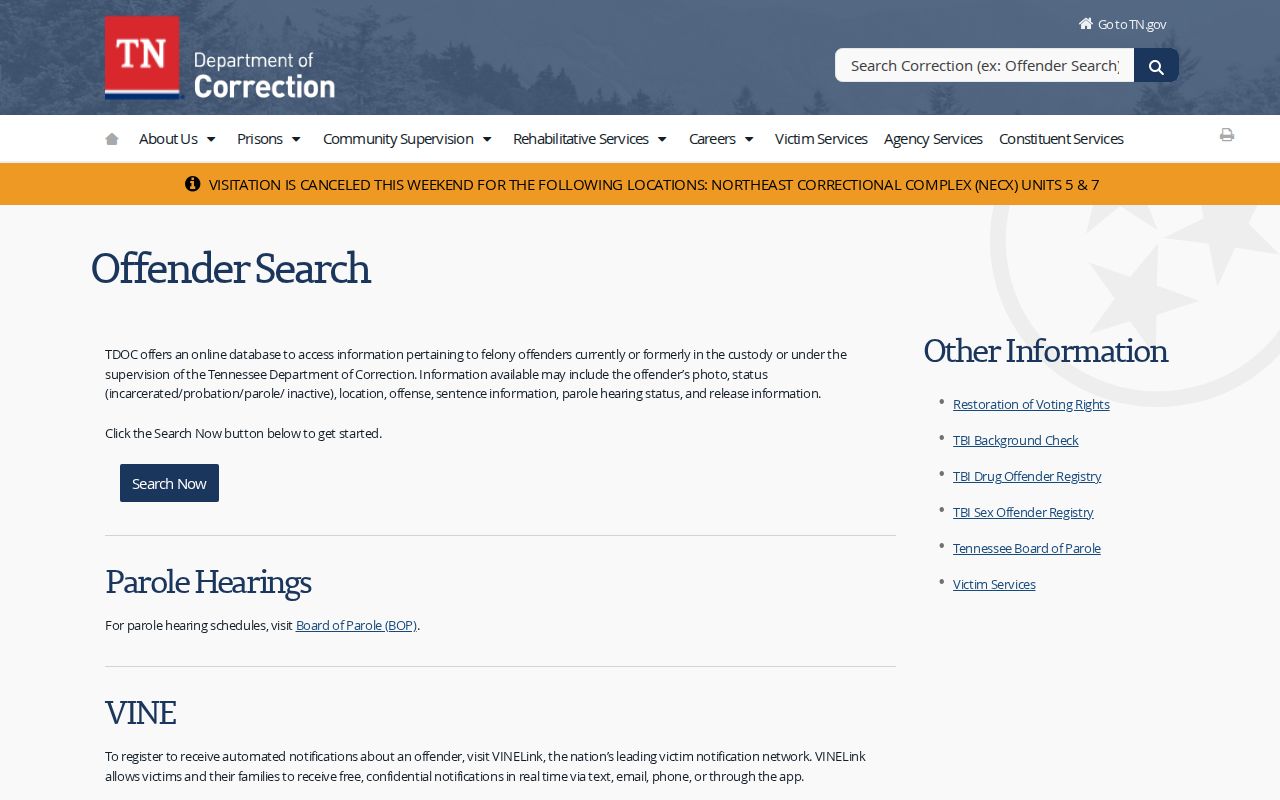
This state overview helps define FOIL's felony scope, which is broader than the live Bradley County Jail booking channel.
The live FOIL search screen supplies the name and state identification routes used for a matching Tennessee felony record.
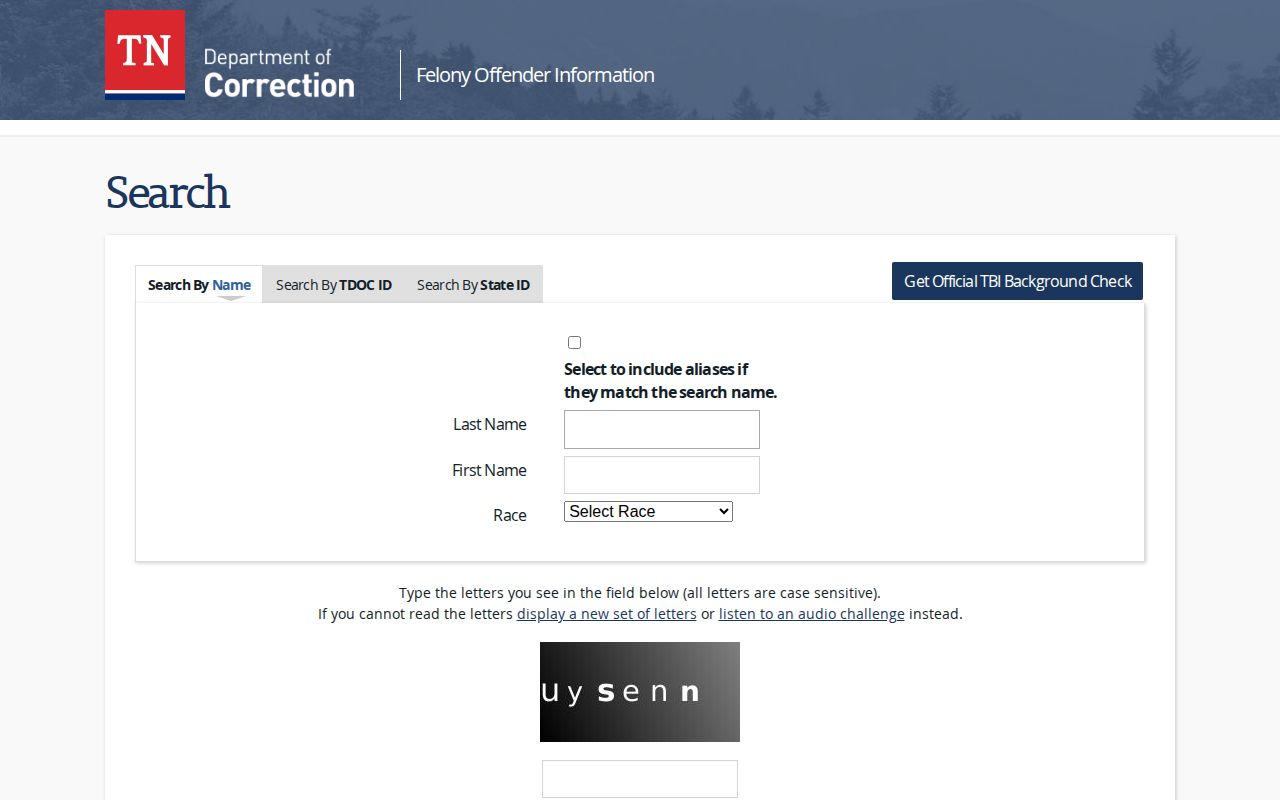
The search screen is the starting point; the matched detail and exact state date labels determine what the result means.
Bradley County Jail Release Date
For a county case, the jail and criminal court answer different parts of the question. Jail staff can confirm whether a person is physically housed and whether a recorded departure was a release or transfer. Bradley General Sessions Criminal Court maintains misdemeanor matters and early felony stages. Circuit Criminal Court maintains felony trial-level records. Its judgment or order explains bond, dismissal, time served, probation, sentence, revocation, or another legal disposition.
A precise written request to the Bradley County Sheriff records channel should ask for an existing booking or admission date, actual release date and time, release disposition, and transfer destination if recorded and public. Include the person's full name, known date of birth, booking number, and a narrow date range. The sheriff materials do not publish a copy-fee schedule, response-time promise, release-data retention period, or guarantee that each desired field is public.
County misdemeanor credits require care as well. Tennessee law gives the sentencing court a role in fixing a misdemeanor release percentage from 30 through 100 percent in ten-point steps. Credits cannot cut that percentage by more than 25 percent. A state felony range percentage should never be used as a Bradley misdemeanor calculator.
Note: A bond amount on a booking report states a term at intake; it does not establish that bond was posted or release followed.
Bradley Release Credits Under Tennessee Law
TCA § 41-21-236 governs sentence-reduction credits. An eligible person may receive between one and sixteen days per month, with no more than eight for good institutional conduct and eight for satisfactory program work. Awards are monthly and discretionary. No person is entitled to a credit or a certain program, and credits can be reviewed or removed.
The law also provides a 60-day credit for specified educational achievements and a separate 60-day credit for qualifying completion of an evidence-based intensive residential substance-use treatment program. Offense-based limits apply. Completion alone does not prove that the credit was available, granted, retained, or permitted to shorten the controlling date.
Discipline can move a calculation in the opposite direction. Credits are unavailable for certain months with disciplinary offenses, and prior credits may be removed for Class A infractions. People classified at maximum security or held in punitive segregation cannot earn the statutory credits. For time served before sentence, a jail administrator may recommend good-behavior credits of up to eight days for each month, subject to the law.
- Sentence effective date
- The calculated beginning of the sentence after rules and applicable jail credit.
- Release eligibility date
- The earliest legal milestone for a release mechanism, not proof of approval or departure.
- Sentence expiration date
- The calculated endpoint of the sentence under the controlling law.
- Detainer
- A notice that another authority may seek custody, which can prevent community release.
Bradley Eligibility Is Not One Percentage
The claim that every Tennessee prisoner serves 85 percent is wrong. The central release eligibility law, TCA § 40-35-501, uses several frameworks. Ordinary sentencing ranges generally begin at 20 percent for mitigated offenders, 30 percent for Range I, 35 percent for Range II, 45 percent for Range III, and 60 percent for career offenders. Offense date, offense-specific subsections, life-sentence rules, mandatory service, and retained credits can change the result.
Section 40-35-501(i) covers listed violent offenses committed on or after July 1, 1995. It generally requires 100 percent less earned and kept credits, while limiting the reduction to 15 percent. That produces the often-cited 85-percent floor for that class. Subsection (y) has another 85-percent structure and distinguishes offenses before and after July 1, 2024.
Specified offenses committed on or after July 1, 2022 can face stricter truth-in-sentencing provisions. Subsection (bb) requires 100 percent without sentence-reduction credits for its listed offenses. Under subsection (cc), another listed group starts at 100 percent, but satisfactory program credits can reduce the percentage served before parole eligibility by up to 15 percent. Those credits do not change expiration. Exact subsection and offense date matter.
Why Bradley Release Dates Change
TDOC is the official felony sentence calculator under TCA § 41-21-1006 for TDOC prisoners and felony offenders sentenced to county jail or workhouse for at least one year. A private estimate can miss pretrial credit, concurrent or consecutive sentences, offense rules, amended judgments, and credits. Even a correct eligibility calculation does not decide the release event.
| Factor | Effect on the Bradley County release path |
|---|---|
| Corrected judgment | Can change sentence terms, effective dates, or the structure TDOC must apply. |
| Pretrial jail credit | Verified credit can change the calculated sentence timeline. |
| Concurrent or consecutive terms | Controls whether sentences overlap or run one after another. |
| Credit award or loss | May advance an eligible date or move it later under the applicable law. |
| Detainer or pending charge | Can prevent release to the community even when eligibility arrives. |
| Parole action and plan | A denial, rescission, or unapproved plan can block physical release. |
| Court order | A new or amended order can alter the legal basis for custody or release. |
FOIL data should be date-stamped because later calculations may supersede the screen. If a label is unclear, use TDOC's record request route rather than assigning it a meaning the state did not publish.
Bradley Release Rules After 2024
For a felony sentence of two years or more based on an offense committed on or after July 1, 2024, § 40-35-501(ff) draws a sharp line between eligibility and expiration. Sentence-reduction credits may advance eligibility for parole, but they do not alter sentence expiration. If release occurs on or after eligibility, the balance of the actual sentence is served on parole.
That rule makes a FOIL or TOMIS eligibility date a legal milestone, not a promised exit date. The person still needs the parole process where applicable. A final favorable action may be followed by pre-release conditions, an approved release plan, a certificate, and the custody-status change. A detainer or pending charge can also prevent community release.
The TDOC Types of Release page shows why release form matters.
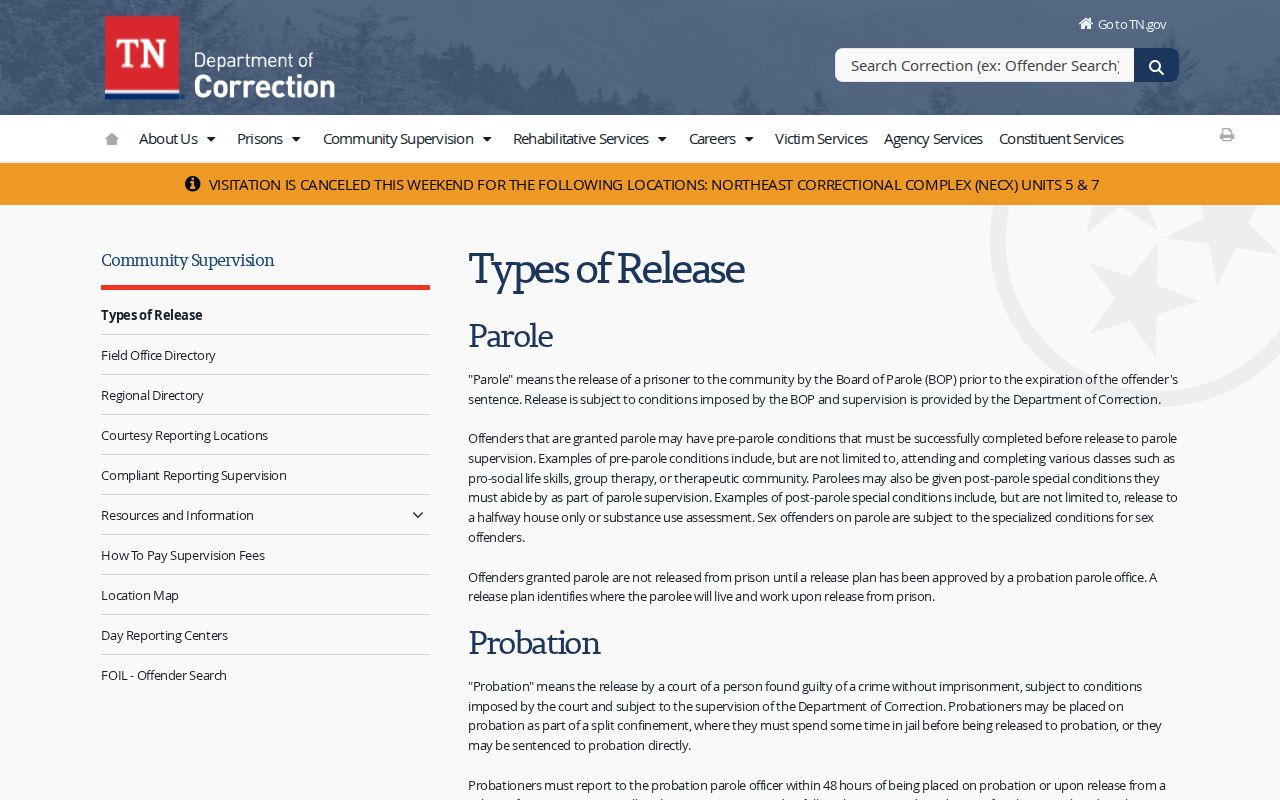
The state descriptions help distinguish parole, probation, determinate release, and mandatory reentry, each of which carries a different path from custody into the community.
Note: Credits that advance parole eligibility under the post-2024 rule do not by themselves shorten the sentence-expiration date.
Confirm Bradley County Actual Release
A parole grant alone does not confirm departure. The Board's final decision, approved release plan, certificate, FOIL status change, and actual release notice form a sequence. A recommendation from a hearing officer is also not the final Board vote. If the person is still shown at a prison or county jail, eligibility did not end physical custody.
For a state sentence, record the exact FOIL labels and ask TDOC for the release document if the online detail is incomplete. For Bradley County Jail, ask whether the person is presently housed and request the existing release or transfer record. Compare that response with the court order. This separates community release from movement to state, federal, immigration, or another local custodian.
Tennessee VINE can add a forward-looking alert or current agency status when the correct reporting agency and record are available. The Bradley County VINELink inmate search covers matching the record and registering for a custody-change notice. VINE does not replace the first-party release record, and a missed result does not prove release.
Keep the source, field label, and date checked with every result. That simple practice prevents an old eligibility date, booking report, or planned hearing from being mistaken for the day a Bradley County person actually left custody.